Safety
LiFePO4 is the most stable lithium chemistry, but a battery stores a lot of energy. Treat it with care.
- Install it with the right polarity, tight cables of the right size, and a fuse.
- Don't open the case, change its firmware or remove the label.
- Keep it within its temperature limits, away from fire, water and direct sun.
- Short-circuiting the terminals can deliver a very high current: keep tools and metal away from them.
Never ship a lithium battery without our instructions: it travels as dangerous goods (UN3480, class 9).
The battery passport
Every Batterieslab battery has a battery passport: a public page with its identity, specifications and condition. Scan the QR code on the label, or open passport.batterieslab.gr/passport?batteryId= followed by the serial number.
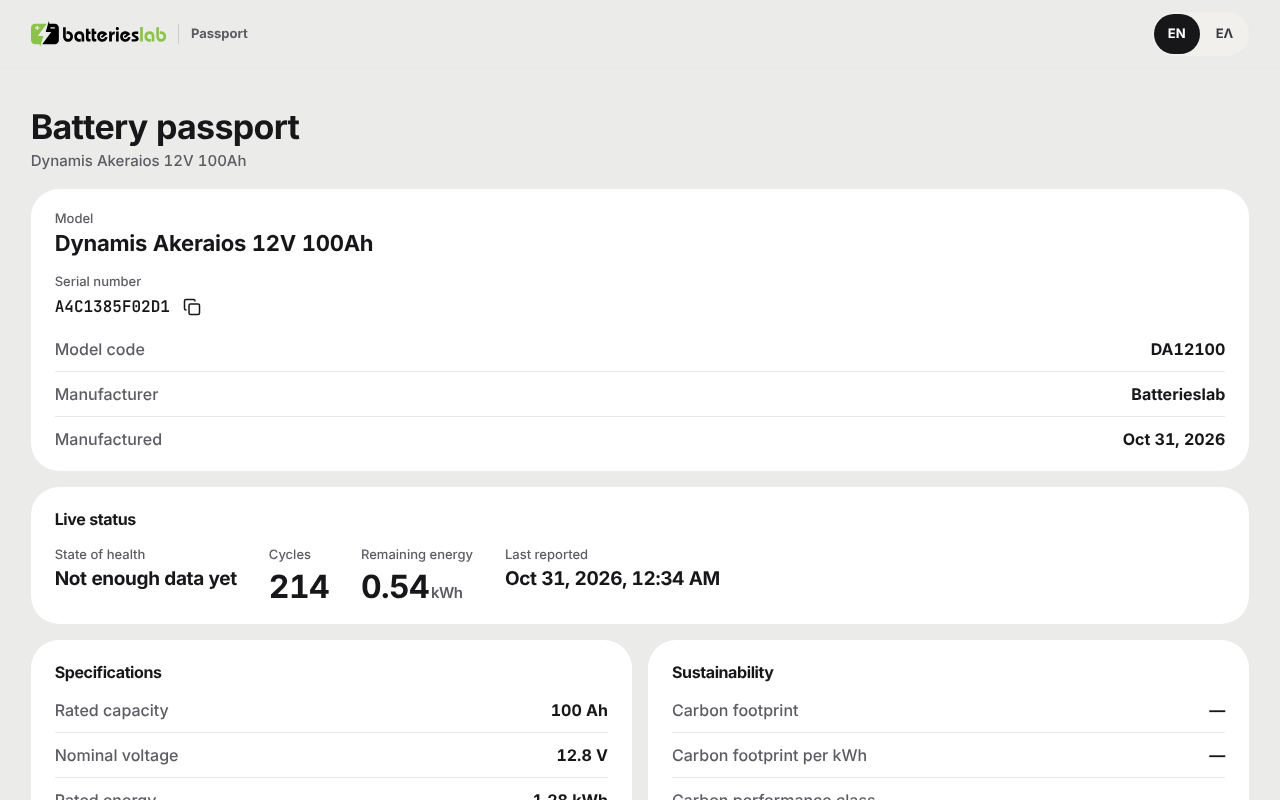
The passport shows:
- the battery type, serial number, manufacturer and date of manufacture;
- Live status: the state of health, cycles, remaining energy and when the battery last reported;
- Specifications: rated capacity and energy, nominal voltage, cell configuration, expected lifetime, operating temperature, efficiency, self-discharge and weight;
- Sustainability: the carbon footprint and recycled content, where declared, and any hazardous substances;
- Protection events: how many times the BMS has protected the battery, by reason.
It never shows the owner, their account, an order or where the battery is.
How the state of health is measured
We don't take the state of health from the BMS. Each night we look for full charges, from 20 % or less up to 100 %, recorded without gaps, and measure the charge the battery actually took. The passport shows the middle of the latest three measurements of the past year, against the battery's rated capacity, up to 100 %. Until there are three, it says Not enough data yet.
A battery seen only over Bluetooth gets such a measurement only when a whole charge happens with Battery Monitor connected. IoT and Ermis batteries report all the time, so theirs fill in by themselves.